Oil stains on pavers are frustrating. Whether it’s a slow leak from a car parked in your driveway or a grease splatter near your outdoor grill, those dark marks seem impossible to shift. You’ve probably already tried scrubbing with soap and water and watched the stain laugh at you. We get it.
Here’s the good news: how to remove oil stains from pavers is not as complicated as it looks. The right method depends on two things: how old the stain is and what type of paver you’re working on. Get those two things right and you can clear most stains without damaging the surface. This guide walks you through 7 proven methods, tells you exactly which products to use, and gives you real cost numbers so you know what to expect.
Table of Contents
ToggleKey Takeaways
- Act fast. Fresh oil is far easier to remove than stains that’s been sitting for days.
- Match the method to the stain age. Old stains need a poultice or commercial degreaser, not just baking soda.
- Never use wire brushes, vinegar on natural stone, or bleach on pavers.
- Seal your pavers after cleaning to stop future stains from soaking in.
- Most DIY cleaning costs between $10 and $60. Professional cleaning runs $150 to $400+ depending on area size.
What You'll Need
Before you start, gather your supplies. Having everything ready saves time and stops the oil from spreading further.
For fresh stains:
- Paper towels or old rags
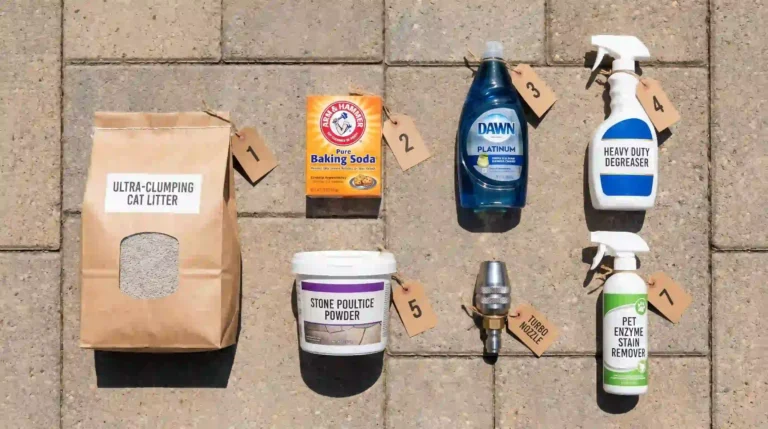
- Cat litter, baking soda, cornstarch, or sawdust
- Stiff-bristled nylon brush (not metal)
- Garden hose or bucket of warm water
- Dish soap (Dawn works well for cutting grease)
For older or deeper stains:
- Commercial paver degreaser (Oil Eater, Simple Green Oxy Solve, or PROSOCO Cleaner/Degreaser)
- Poultice cleaner (PROSOCO Oil & Grease Stain Remover, or DIY mix)
- Pressure washer (400–1,000 PSI nothing higher)
- Protective gloves and safety glasses
- Plastic sheeting or tape (for poultice method)
Approximate product costs:
- Cat litter or baking soda: $3–$6
- Dish soap (Dawn): $4–$7
- Simple Green Oxy Solve (1 gallon): $18–$25
- PROSOCO Cleaner/Degreaser (1 gallon): $30–$45
- PROSOCO Oil & Grease Stain Remover (1 quart, covers up to 6 sq ft): $35–$50
- Oil Eater Original (1 gallon): $20–$28
How Stain Age Changes Everything
This is the step most guides skip and it’s why people end up scrubbing for hours with no result.
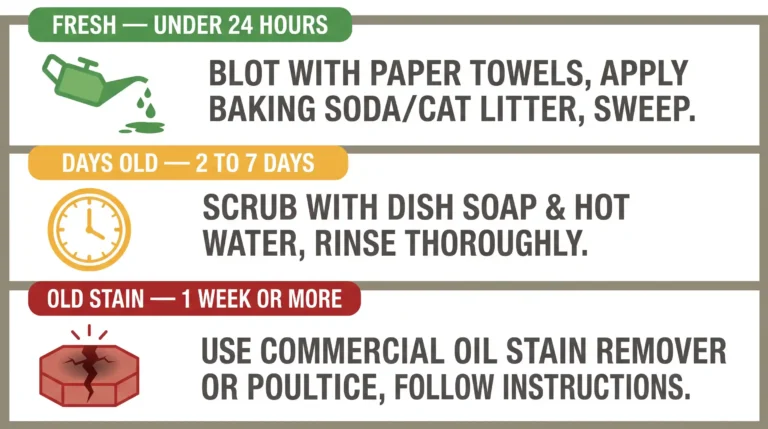
- Fresh stain (under 24 hours): The oil is still near the surface. Absorbent materials and dish soap are often enough.
- Days-old stain (2–7 days): Oil has started to bond with the paver’s pores. You’ll need a commercial degreaser with a proper dwell time.
- Old stain (1 week or more): The oil has penetrated deep. A poultice is your best option. Multiple applications may be needed.
When in doubt, assume the stain is older than it looks. Pavers are porous oil that moves fast below the surface.
Know Your Paver Type First
This matters more than most people realize. The wrong cleaner on the wrong paver can cause more damage than the stain itself.
- Concrete pavers: Most forgiving. Handle degreasers, baking soda, dish soap, and pressure washing well.
- Brick pavers: Similar to concrete. Avoid acidic cleaners. The nylon brush only has no wire.
- Natural stone (travertine, limestone, sandstone): The most sensitive. Avoid vinegar, bleach, and any acidic product. Always use pH-neutral cleaners. Always test in a hidden spot first.
- Porcelain pavers: Low porosity, so oil doesn’t soak in as deep. Mild degreaser and a soft brush usually does the job.
How to Remove Oil Stains from Pavers: 7 Proven Methods
Method 1: Absorb It Fast (Best for Fresh Spills — Under 24 Hours)
This is your first move the moment you spot a spill. Speed matters.
- Blot the oil with paper towels or a clean rag. Press down gently, don’t rub or spread it.
- Generously cover the stain with cat litter, baking soda, cornstarch, or sawdust.
- Let it sit for at least 30 minutes. For larger spills, leave it overnight.
- Sweep up the material and dispose of it.
- Scrub the area with dish soap and warm water using a nylon brush.
- Rinse thoroughly with a garden hose.
Why it works: These absorbent materials pull oil out of the paver’s pores through capillary action. The powder visibly darkens as it works that means it’s pulling oil up, not just sitting there.
Cost: Under $10 using household items.
Method 2: Dish Soap and Hot Water (Best for Fresh to 3-Day Stains)
Simple and effective for stains that haven’t gone too deep yet.
- Pour undiluted dish soap (Dawn or similar grease-cutting soap) directly onto the stain.
- Let it sit for 20–30 minutes.
- Add a little warm water and scrub with a stiff nylon brush in circular motions.
- Rinse with hot water and a strong hose spray.
- Repeat if the stain is still visible.
Pro tip: Hot water matters here. It helps break down the oil’s surface tension and lifts residue more effectively than cold water.
Cost: Under $10.
Method 3: Baking Soda Paste (Best for Concrete and Brick Pavers)
Baking soda is safe, cheap, and mildly abrasive a solid all-rounder for concrete and brick.
- Mix baking soda with just enough warm water to form a thick paste.
- Apply it generously over the stain and press it in slightly.
- Let the paste dry completely, this can take 1–3 hours.
- As it dries, it draws the oil up out of the pores.
- Scrub with a nylon brush once dry.
- Rinse thoroughly with warm water.
Note: Do not use baking soda on natural stone pavers like limestone or travertine. The mild abrasion can dull polished surfaces over time.
Cost: Under $5.
Method 4: Commercial Paver Degreaser (Best for 3-Day to 2-Week Stains)
When household methods stop working, a commercial degreaser is the next step. This is what professional landscapers and contractors reach for.
Recommended products:
- Simple Green Oxy Solve: Safe for most paver types. Biodegradable. Mix 1 part product to 10 parts water for general use.
- Oil Eater Original: Strong on motor oil and grease. Use undiluted on heavy stains.
- PROSOCO Cleaner/Degreaser: Professional-grade. For heavy stains, dilute 1:4 (product to water). For lighter stains, go as diluted as 1:200.
Steps:
- Wet the stained area lightly first.
- Apply the diluted degreaser directly onto the stain.
- Let it dwell for 5–15 minutes (check the product label).
- Scrub with a stiff nylon brush.
- Rinse with clean water. A pressure washer at 400–800 PSI works well here.
- Repeat if some stains need two applications.
Important: Apply cleaners when surface temperatures are above 50°F. Cold pavers don’t absorb cleaners properly, and products applied below freezing can damage the surface.
Cost: $18–$45 depending on product and quantity.
Method 5: Poultice Method (Best for Old, Deep-Set Stains — 2 Weeks or More)
This is the most effective method for removing oil stains from pavers that have had time to bond deep with the stone. It works by drawing oil back up to the surface as the paste dries.
Option A. Commercial poultice: Use PROSOCO Oil & Grease Stain Remover. It comes ready to pour, has a thick consistency, and covers up to 6 sq ft per quart.
Option B. DIY poultice: Mix diatomaceous earth or baking soda with a paver-safe degreaser (not water) to form a thick paste aimed for a consistency like peanut butter.
Steps:
- Pour or spread the poultice generously over the entire stain.
- Cover with plastic sheeting and tape the edges down.
- Let it sit for 24–48 hours. The plastic slows drying and forces the paste to pull oil upward rather than just dry out.
- Remove the plastic. You’ll see cracks forming in the poultice that’s normal and means it’s working.
- Once fully dry, sweep up the material with a stiff brush and dustpan.
- Rinse the area with clean water.
- Repeat for severe stains.
Cost: $35–$50 for commercial poultice per quart. DIY version under $15.
Method 6: Pressure Washing (Best Combined with a Degreaser)
Pressure washing alone won’t fully remove oil stains; the water pushes the stain around more than it lifts it. But combined with a degreaser, it’s a powerful tool.
- Apply a paver-safe degreaser first and let it dwell for 10–15 minutes.
- Set your pressure washer to 400–1,000 PSI with a wide fan nozzle (25° or 40° tip).
- Keep the nozzle at least 12 inches from the surface.
- Work in consistent sweeping motions doesn’t blast one spot repeatedly.
- Rinse the full area and inspect once dry.
What to watch out for:
- Anything over 1,200 PSI can etch concrete pavers and erode joint sand.
- Never use a zero-degree (pencil jet) nozzle on pavers.
- After pressure washing, check your joints. If polymeric sand has washed out, it needs to be replaced before water and weeds get in.
Cost: Pressure washer rental runs $50–$100/day. Professional pressure washing service: $100–$250 for a standard driveway.
Method 7: Enzymatic Cleaner (Best Eco-Friendly Option)
Enzymatic cleaners use natural proteins (enzymes) to biodegrade oil at a molecular level. They convert petroleum-based oils into water and carbon dioxide with no harsh chemicals needed.
This method is slower but safe for all paver types including natural stone. It’s also the best choice if you have plants or grass nearby that you want to protect.
- Choose an enzymatic cleaner designed for petroleum-based oils (look for “enzyme” or “bioremediation” on the label).
- Apply it directly onto the stain to ensure full coverage.
- Let it sit for several hours or overnight. Enzymes need time to work.
- Scrub lightly with a nylon brush.
- Rinse with water.
- Reapply if needed deeper stains may take 2–3 treatments.
Cost: $20–$40 per bottle. Covers 50–200 sq ft depending on product.
How to Handle Deeper Oil Stains on Pavers
Some stains have been there for several months. Perhaps you’ve just spotted them. Perhaps the stain on the surface has disappeared after cleaning, but a darker shadow still exists. Oil is bonded deep into the pores of the paver, creating that shadow.
The fact is that stains that are very ancient and firmly embedded cannot be completely removed. However, you can usually get them to the point where they are hardly perceptible.
What to do:
Start with a commercial degreaser (Method 4). Apply it, let it dwell for the full recommended time, scrub, rinse, and let the paver dry completely for at least 24 hours. Wet pavers look darker and hide how much the stain has actually faded.
If a shadow remains after drying, move to the poultice method (Method 5). Do at least two full applications with 24–48 hours between each.
For stains larger than 10–15 square feet, or stains on high-value natural stone, professional cleaning is worth the cost. A pro with commercial-grade equipment and the right chemistry will get better results than repeated DIY attempts and with less risk of surface damage.
What NOT to Use on Pavers
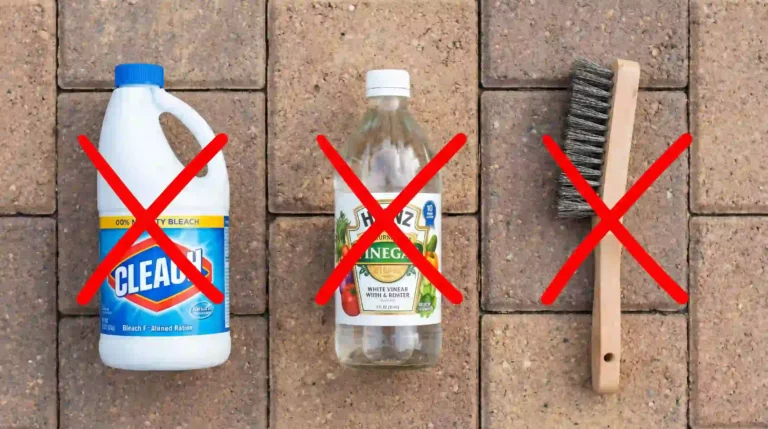
This section could save you a costly mistake.
Avoid these on all pavers:
- Wire or metal brushes: scratch and scar the surface permanently
- Bleach: discolors pavers and kills nearby plants
- Muriatic acid: permanently damages color and texture on concrete and stone
- High-pressure above 1,200 PSI: erodes joint sand and can etch the surface
Avoid these specifically on natural stone:
- Vinegar: the acetic acid etches limestone, travertine, and sandstone
- Ammonia-based cleaners: strips sealers and dulls polished stone
- Any acidic cleaner: even mild acids cause surface damage over time
On using vinegar to remove oil stains from brick pavers: Vinegar works on some brick and concrete pavers for light stains but only if the brick is not natural stone. Even then, rinse thoroughly after use. If you’re unsure what your pavers are made of, skip vinegar and use a pH-neutral degreaser instead. The risk isn’t worth it.
Seal Your Pavers After Cleaning
This step gets skipped constantly, and it’s the reason the same stains come back.
Pavers have a porous nature. If you skip the sealer, the oil just soaks right in. A good sealer will stay on the surface long enough for you to blot it up before it really sticks.
Once you’ve cleaned everything up and the pavers are completely dry (give it at least 24–48 hours), go ahead and apply a penetrating paver sealer. So, a water-based acrylic sealer is pretty popular and usually runs between $25 and $60 per gallon. It can cover about 200 to 400 square feet, give or take.
If you’ve got a driveway that sees a lot of vehicle traffic, a polyurethane sealer is a great choice. It provides solid protection and usually lasts around 3 to 5 years before you need to reapply it. They run between $40 and $90 a gallon.
It’s a good idea to reseal every 2 to 3 years if everything’s normal.
When to Call a Professional
DIY works well for most stains. But there are situations where professional help makes sense:
- The stained area is larger than 15–20 square feet
- You’ve done 3+ treatments and the stain is still clearly visible
- Your pavers are high-value natural stone (travertine, bluestone, limestone)
- The stain has been there for over 6 months
- You don’t have time or equipment for repeated treatments
Professional paver cleaning typically costs $150 to $400 for a standard residential driveway in most U.S. markets. In premium areas or for specialty stones, costs can go higher.
At Lakota Design Group, we’ve worked on paver driveways, patios, and walkways across the Bay Area for years. We see oil stains on nearly every second project from motor oil on concrete driveways to cooking grease near outdoor kitchens. If your stain is past what DIY can handle, or if your pavers need professional attention alongside our paver installation services in San Jose, we’re here to help. Contact Lakota Design Group today for a free consultation and let us restore your pavers the right way.
FAQs about Removing Oil Stains from Pavers
What is the best product to remove oil stains from pavers?
For surface stains, Simple Green Oxy Solve or Oil Eater work well and are safe for most paver types. For deep, older stains, PROSOCO Oil & Grease Stain Remover (a poultice) is one of the most effective options available. Always check that the product is safe for your specific paver material before applying.
How do you remove oil stains from pavers that have been there a long time?
Old stains need a poultice either commercial or DIY. Apply it, cover with plastic, and leave for 24–48 hours. Expect to repeat the process 2–3 times for stains older than a month. Combine with a commercial degreaser for best results.
Can I use vinegar to remove oil stains from brick pavers?
On standard brick or concrete pavers, diluted white vinegar (1:1 with water) can help with light grease stains. However, do not use vinegar on natural stone pavers; it causes etching and surface damage. Even on brick, rinse thoroughly and monitor for any discoloration.
How do you remove oil from driveway block paving?
The same methods apply. Start with absorbent materials if the spill is fresh. For older stains on block paving, a commercial degreaser with a 10–15 minute dwell time followed by pressure washing at 400–800 PSI gives the best results. Finish with a sealer to prevent repeat staining.
Will a pressure washer fully remove driveway oil stains on its own?
Not reliably. Pressure washing without a pre-applied degreaser mostly spreads the oil rather than lifting it. Always apply a degreaser first, let it break down the oil, then rinse with a pressure washer set to 400–1,000 PSI using a wide fan nozzle.
How do I remove oil stains from pavers without damaging them?
Use a pH-neutral or paver-safe degreaser, a nylon brush, and water. Avoid wire brushes, muriatic acid, bleach, and high-pressure above 1,200 PSI. On natural stone, always test your cleaner on a small hidden area first. When in doubt, go gentler you can always apply a second treatment.
How often should I seal my pavers?
Every 2–3 years under normal use. High-traffic driveways or areas exposed to regular vehicle leaks may benefit from resealing every 18 months. Always clean the pavers thoroughly before applying any new sealer.