Cutting concrete pavers is one of those tasks that looks hard but gets easy fast once you know what you’re doing. Most homeowners crack their first few pavers not because the job is difficult, but because they used the wrong tool or skipped one simple step. The good news? You don’t need to be a professional to get clean, straight cuts that fit perfectly into your patio, walkway, or driveway.
This guide covers everything: the right tools, the exact steps, common mistakes to avoid, and when a specific method works better than another. Whether you’re trimming edge pieces for a patio border or fitting pavers around a curve, you’ll know exactly what to do by the end.
Table of Contents
ToggleBefore You Cut Pavers
Rushing straight to cutting is the #1 reason pavers crack unevenly. A few minutes of prep saves you wasted material and frustration.
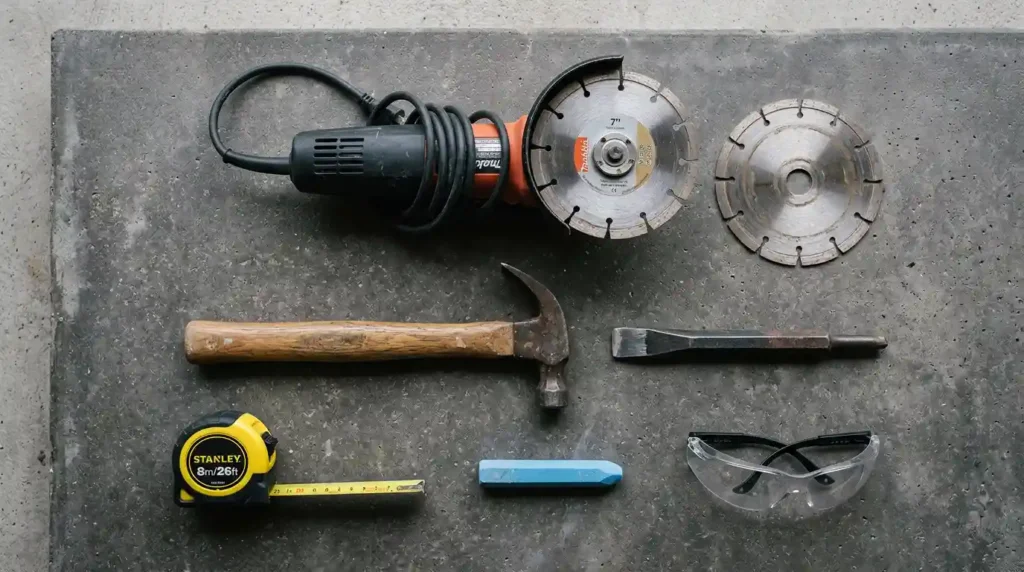
Measure twice, mark clearly. Use a tape measure to mark exactly where you need the cut. Draw the line with a chalk pencil or permanent marker across the top, bottom, and both sides of the paver. This gives you a guide on all surfaces when scoring.
Buy extra pavers. Plan for 5–10% more pavers than your project needs. Cuts go wrong, pavers chip, and having spares on hand means you won’t stop mid-project waiting on a delivery.
Check paver thickness. Standard concrete pavers are 2 3/8 inches thick. Larger driveway pavers can be 3 1/8 inches. Thickness determines which tool you need. Thin pavers can be scored and snapped. Thicker ones need a saw.
Set up a stable work surface. Place the paver on a flat, non-slip mat. If the paver rocks during cutting, it will crack off the line. Two sawhorses with a piece of plywood on top works well if you don’t have a dedicated work table.
Get your safety gear on before anything else. This is not optional.
- Safety goggles (not just glasses)
- N95 or higher dust mask concrete dust contains silica, which causes serious lung damage over time
- Ear protection if using power tools
- Work gloves for handling cut pieces
Essential Tools for Cutting Concrete Pavers
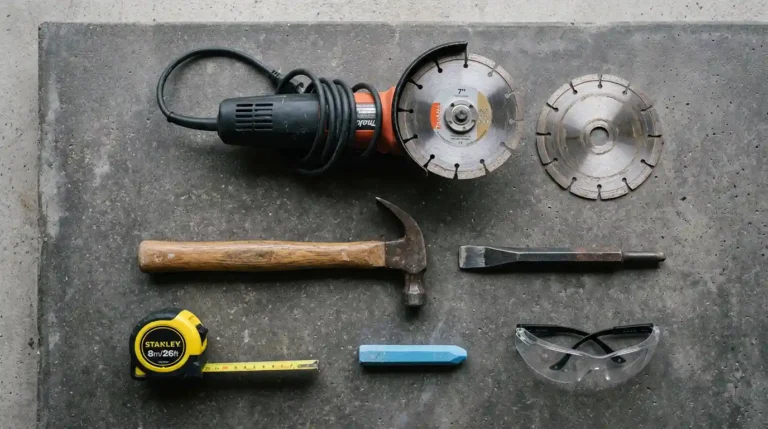
Picking the right tool saves time and gives you a cleaner result. Here’s a breakdown of each option and when to use it.
Angle Grinder
Best for: Small projects, detail cuts, trimming edges
An angle grinder with a 4.5-inch diamond blade handles most DIY paver jobs well. It’s portable, easy to control, and good for cutting around curves or tight spots. The downside is dust dry cutting with a grinder produces a lot of it.
Use a segmented diamond blade for general cutting. Use a continuous rim diamond blade when you need a smooth, chip-free edge.
Wet Saw (Table-Style Paver Saw)
Best for: Large projects, thick pavers, precision cuts, porcelain pavers
A wet saw is the professional standard for cutting pavers. Water flows over the blade continuously, which cools it down, reduces dust almost completely, and prevents chipping. If you’re cutting more than 20–30 pavers, renting a wet saw from a tool rental shop is worth every dollar.
This is also the right tool for cutting porcelain pavers, which chip easily with dry methods.
Circular Saw with Diamond Blade
Best for: Straight cuts on standard-thickness concrete pavers
A standard circular saw works for cutting pavers when fitted with a 7.5-inch diamond blade. Use it for straight cuts only. Set the blade depth to about 1/4 inch for the first pass, then increase depth on each subsequent pass. Don’t try to cut all the way through in one go.
This is a solid option if you already own a circular saw and don’t want to rent equipment for a small job.
Hammer and Chisel (Score and Snap)
Best for: A few cuts, rough edges, no power available
No electricity needed. No rental cost. For 5–10 cuts on a small project, a cold chisel and hammer does the job. The cut won’t be as precise as a saw, but for edge pieces that sit against a border or wall, it works fine.
Masonry Saw / Cut-Off Saw
Best for: Heavy-duty projects, retaining walls, large volumes of cutting
A cut-off saw (also called a demolition saw or concrete saw) is a high-powered handheld tool built for volume cutting. Contractors use these on large driveway and retaining wall projects. For most DIYers, this is overkill unless you’re doing a very large job.
How to Cut Concrete Pavers With a Hammer and Chisel: Step-by-Step
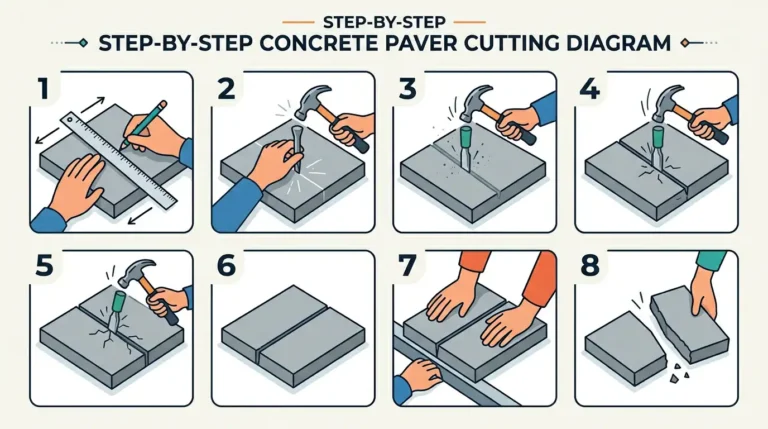
This method is straightforward and works well for concrete and softer brick pavers.
What you need:
- Cold chisel (1-inch wide)
- brick-set chisel, hammer
- non-slip mat
Step 1: Set Up a Flat Base
Place a piece of plywood over a sturdy workbench or flat ground. Put a non-slip rubber mat on top of the plywood. This absorbs vibration and keeps the block from sliding around while you strike it.
Step 2: Score the Line
Take a one-inch wide cold chisel. Place the sharp edge directly on your chalk line. Tap the top of the chisel gently with a club hammer or rubber mallet. Move the chisel along the line, tapping as you go, to create a shallow groove about 1/16-inch deep. Repeat this on the top, bottom, and side faces of the block.
Step 3: Make the Final Split
Place the scored block flat on the mat. Set a wide brick bolster chisel directly inside the scored groove on the top surface. Strike the top of the chisel with a firm, heavy blow using your club hammer. The block will snap cleanly along your scored line.
Step 4: Clean the Edge
If the break leaves any rough bumps or protrusions, use the corner of your cold chisel to chip them away. Rub a coarse masonry rasp or rubbing stone against the edge to create a smooth, clean finish.
Pro tip: If the paver doesn’t split on the first strike, don’t chip away randomly. Re-score the groove deeper and try again.
Can I Cut Pavers With a Concrete Saw?
Yes and for larger jobs, it’s one of the best ways to cut pavers efficiently.
A concrete saw (also called a cut-off saw) uses a diamond blade and cuts through thick paving stones quickly. Some models have a built-in water feed for wet cutting, which is ideal for controlling silica dust.
Here’s how to do it safely:
- Step 1: Mark your cut line on the top and bottom of the paver.
- Step 2: Clamp the paver on a stable surface if possible.
- Step 3: Make a shallow scoring pass first about 1/4 inch deep along the marked line.
- Step 4: Make additional passes, increasing depth gradually. Don’t force the blade. Let the saw do the work at a steady, consistent speed.
- Step 5: Stop every 30 seconds to let the blade cool if dry cutting. If using a wet saw, the water handles this for you.
- Step 6: Smooth rough edges with a rubbing stone after the cut.
For cutting pavers with a circular saw, follow the same method of multiple shallow passes rather than one deep cut.
How to Cut Holes in Concrete Pavers
Sometimes you need to create round openings in the middle of a block to fit around outdoor lighting posts, water pipes, or drainage grates.
What you need: Rotary hammer drill or electric hammer drill, masonry drill bits (tungsten carbide tip)
- Step 1: Mark the center point of the hole on the paver surface.
- Step 2: Place the paver flat on a stable surface. Make sure nothing is directly under the spot you’re drilling through.
- Step 3: Set the drill to high speed. Hold it as straight up-and-down as possible to avoid drilling at an angle.
- Step 4: Drill slowly and steadily. Don’t press hard, let the drill bit do the work.
- Step 5: Stop when the bit breaks through the bottom. If you need a larger hole, switch to a bigger bit and repeat.
Important: Use a rotary hammer on newer concrete pavers. For older, denser concrete, an electric hammer drill works better. Standard drill bits will not cut through concrete; you need masonry bits specifically.
How to Cut Curved Pavers
Curved cuts are one of the most common needs on patio and pool deck projects, and almost no guide covers it properly.
Method 1. Angle Grinder: This is the best tool for cutting curves. Mark the curve with chalk or a flexible straightedge. Make small, incremental cuts along the curve rather than trying to follow the line in one continuous pass. Work slowly. An angle grinder gives you the control needed for gentle curves.
Method 2. Multiple Straight Cuts: For tighter curves, make a series of straight cuts that follow the curve line in small steps. Then use a hammer and chisel to knock off the jagged edges. Finish with a rubbing stone.
Method 3. Grinder + Chisel combination: Score the curve with the grinder, then use the chisel to break off small sections along the scored line.
Curved cuts take practice. Always cut on the waste side of the line you can always remove more material, but you can’t add it back.
Wet Cutting vs. Dry Cutting: Which One Is Right for You?
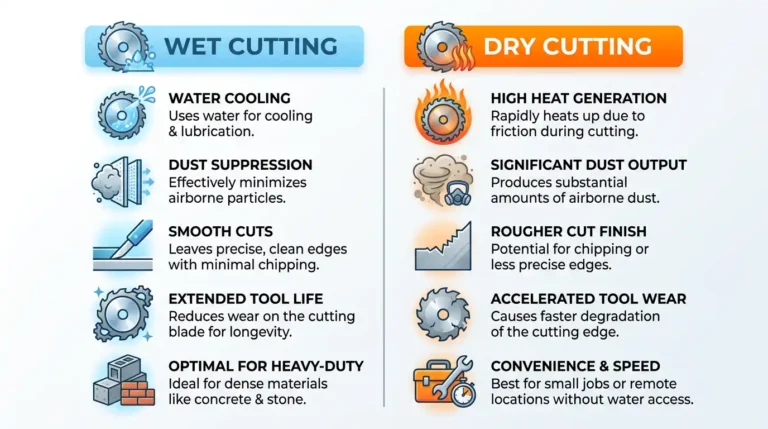
Wet Cutting | Dry Cutting | |
Dust control | Excellent | Poor |
Cut quality | Cleaner, less chipping | More chipping possible |
Setup | Requires water source | No water needed |
Best for | Large projects, porcelain, thick pavers | Quick cuts, small jobs |
Tool needed | Wet saw or wet-capable grinder | Angle grinder, circular saw |
Health risk | Low | High (silica dust) |
For any project with more than 15–20 cuts, wet cutting is the safer and smarter choice.
Achieving Professional Results: Quality Control Tips
Getting a clean cut is one thing. Getting a cut that fits perfectly into your project is another.
Test fit before setting. Before you lock any cut paver into place, drop it into position and check the fit. A small adjustment now takes seconds. Fixing it after it’s set takes much longer.
Don’t rush the blade. The most common cause of chipping and uneven cuts is moving the blade too fast. Let the blade move at its own pace. Applying extra pressure doesn’t speed up the cut, it just increases the chance of cracking.
Replace dull blades. A worn blade drags and vibrates instead of cutting cleanly. If your cuts are getting rougher, check the blade before checking your technique.
Smooth every edge. A quick pass with a rubbing stone on every cut edge removes sharp points and helps the paver sit flush with its neighbors.
Project-Specific Tips
- Patio edges and borders: These cuts are mostly straight, so a circular saw or angle grinder works well. Mark each piece individually rather than assuming they’re all the same size; slight variations in the base can change the fit.
- Driveway pavers: These are usually thicker and denser. A wet saw with a diamond blade is the right call. Don’t try to score and snap thick driveway pavers they won’t break cleanly.
- Walkways with curves: Use an angle grinder for the curved edge pieces. Take your time and work in small passes.
- Retaining walls: Cuts here don’t need to be perfect since they’re often partially buried or covered. A cut-off saw works well for the volume of cuts retaining wall projects require.
- Cutting 12×12 concrete pavers: Their size and weight make them harder to handle. Support the full length of the paver on your work surface so it doesn’t rock. Use a wet saw for clean results. Score the line before applying full blade depth.
When to Call a Professional Instead
Not every cut is worth attempting yourself. If your project involves any of the following, getting a professional involved saves time, material, and frustration:
- Complex curved patterns across an entire patio
- Porcelain pavers (extremely chip-prone without the right wet saw setup)
- Cutting around irregular structures like curved retaining walls or custom water features
- Large-scale driveway projects with tight tolerances
If you’re in the San Jose area and your project has grown past comfortable DIY territory, Lakota Design Group provides professional paver installation services in San Jose backed by 50 years of Bay Area experience. The team handles precise cuts, complex patterns, and full installations including 3D design previews so you see the finished result before any work begins.
FAQs About Cutting Concrete Pavers
What is the best way to cut pavers without a saw?
The score-and-snap method using a cold chisel and hammer is the most practical no-saw option. Mark your line clearly, score a groove 1/16 inch deep around all four sides, then strike a brick-set chisel in the groove. It works well on standard concrete and brick pavers.
Can I cut pavers with a regular circular saw?
Yes, but only with a diamond blade installed. A standard wood-cutting blade will not work and is dangerous. Cutting pavers with a circular saw requires multiple shallow passes rather than one deep cut.
What saw is best for cutting pavers?
A wet saw with a diamond blade gives the cleanest, most consistent results. For smaller jobs, an angle grinder with a diamond blade is a practical and affordable option.
How do I stop pavers from cracking when I cut them?
Score the paver first before applying full cutting depth. Make sure it’s sitting flat on a stable, non-slip surface. Use the right blade for the material and don’t force the cut.
Do I need water when cutting concrete pavers?
You don’t need it, but it helps a lot. Water cools the blade, reduces chipping, and controls silica dust. For any job with multiple cuts, wet cutting is the better choice.
How deep should I score a paver before snapping it?
A 1/16-inch groove scored around all four sides is enough. You don’t need to cut deep; the score just gives the paver a clean line to break along.
Can I cut pavers with an angle grinder?
Yes. An angle grinder with a 4.5-inch diamond blade handles most concrete paver cuts well. It’s especially useful for curved cuts and detailed work around edges.