Planning a turf football field is a big decision. You already know it costs serious money. But what you need right now is a real number, not vague estimates that leave you guessing when you sit down with your budget committee.
So here it is upfront: how much does a turf football field cost? Most full-size installations run between $500,000 and $1,500,000. That wide range exists because no two fields are the same. Site conditions, materials, drainage, and add-ons all push costs up or down. This article breaks it all down clearly so you can walk into any vendor meeting fully prepared.
So, Exactly How Much Does a Turf Football Field Cost?
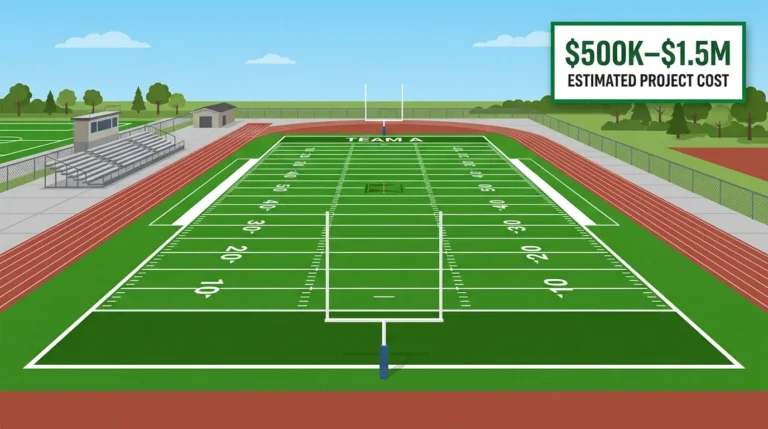
Let’s start with the numbers your stakeholders will ask for.
A standard American football field (360 ft x 160 ft = 57,600 sq ft of playing surface) typically costs:
Total Project Cost: $500,000 – $1,500,000+
In cost-per-square-foot terms, most complete installations fall between $9 and $26 per sq ft. That number covers everything from ground preparation to the finished turf surface.
Here’s a general per-square-foot breakdown:
Component | Cost Per Sq Ft |
Base Preparation, Grading & Drainage | $4 – $10 |
Artificial Turf System (turf + infill) | $4 – $9 |
Installation Labor | $2 – $7 |
Total | $9 – $26+ |
A simple practice field with little site work can cost close to $500,000. A full competition field with high-quality turf, LED lights, a scoreboard, and complicated drainage can easily cost more than $1.2 million. Top-tier college or professional fields might cost more than $1.5 million.
These are real-world numbers. Not back-of-napkin estimates.
Key Factors That Drive the Final Cost
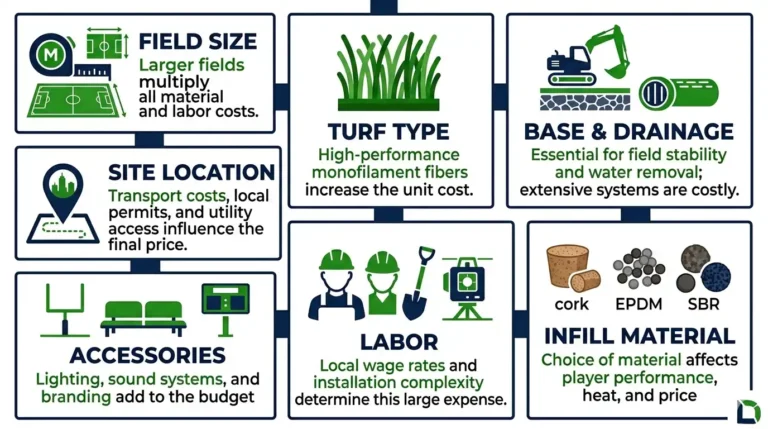
1. Field Size
More square footage equals more of everything. Material costs, labor costs, and infill all scale with size. A practice field at 40,000 sq ft costs far less than a full stadium field at 100,000 sq ft including runoff zones, sidelines, and end zone safety areas.
Always calculate the total project area, not just the 57,600 sq ft playing surface. Safety buffers around the field add square footage that needs the same turf system.
2. Turf Type and Quality
Not all synthetic turf is equal. The three main fiber types are:
- Monofilament – Individual blades that look like real grass. Higher cost, strong aesthetics.
- Slit-film – Wider, perforated yarn. Very durable. Popular on high-traffic fields.
- Hybrid (dual-fiber) – Combines both. Middle ground on cost and performance.
Beyond fiber type, face weight, pile height, and stitch rate all affect how the turf plays, how long it lasts, and what it costs. A higher face weight means more yarn per yard, which means more durability and a higher price. Premium synthetic turf materials can include heat-reduction coatings and antimicrobial protection, both of which add to the artificial turf football field installation cost.
3. Base Preparation and Drainage
This is the line item most buyers underestimate. It often represents 35–50% of the total field construction budget.
Here’s why: proper turf installation starts below the surface. The soil has to be excavated, graded to precise slopes using laser grading, compacted, and layered with crushed stone aggregate for stability. A full drainage system sits beneath that, including perimeter drains, trench drains, or a blanket drain layer depending on your site.
Poor drainage = standing water = damaged turf and voided warranties. Skipping proper base work is the most expensive mistake you can make. You’ll pay for it in premature field replacement.
Sites with heavy clay soil, high water tables, or significant slope changes cost more to prepare than flat, well-draining lots.
4. Infill Material
Infill sits between the turf blades. It provides cushioning, supports fiber structure, and directly affects player safety.
Common options and their cost implications:
- SBR Crumb Rubber (recycled tires) – Lowest cost, proven performance, some heat and environmental concerns
- EPDM Rubber Granules – Virgin rubber, cleaner profile, higher cost
- TPE (Thermoplastic Elastomer) – Recyclable, durable, mid-to-high cost
- Organic Infills (cork, coconut fiber, walnut shells) – Natural feel, premium pricing
- Coated or Cooling Sand – Used in heat-reduction systems, adds cost
In some cases, a shock pad is installed beneath the turf independent of infill choice. This adds cushioning and protects against high Gmax values, which is a key player safety metric. Shock pads are common on football fields and are worth the added cost from a liability perspective.
5. Labor and Installation Expertise
Field turf installation is not general contracting work. It requires specialized crews, precision equipment for spreading infill evenly, and experience seaming large turf rolls without visible joints or weak spots.
Labor rates vary by region. Union labor markets in the Northeast and West Coast run higher than right-to-work states. A field builder in rural Texas will price differently than one operating in New Jersey. Labor typically accounts for 15–25% of total project cost.
Choosing based on the lowest bid is a risk. Check completed fields that are 5+ years old. Ask for references. A poorly installed field can fail in 4–5 years instead of the expected 10–12.
6. Accessories and Site Features
The turf itself is not the whole project. A functional football field often includes:
- Goal posts (high school, NCAA, or NFL spec)
- LED field lighting ($150,000 – $400,000+ depending on output)
- Scoreboard (basic to full video board)
- Perimeter fencing
- Bleachers and spectator seating
- Sound system
- Team benches and water stations
- Branded hash marks and logo artwork in the turf
Each of these adds to the total sports facility budget. Lighting alone can represent a significant portion of the overall spend for facilities hosting evening games.
7. Site Location and Access
Remote sites cost more to service. Trucking heavy turf rolls and aggregate to a difficult location adds freight. Tight site access requiring special equipment adds labor. Local permit fees, environmental assessments, and stormwater management plans can also add time and cost. Factor these in early.
Cost to Install a Turf Football Field
Here’s a practical cost summary for a standard 57,600 sq ft high school football field:
Budget Level | Estimated Total Cost | What’s Included |
Entry-Level | $500,000 – $700,000 | Standard turf, basic drainage, SBR infill, no lighting |
Mid-Range | $700,000 – $1,100,000 | Quality turf, full drainage system, alternative infill, basic lighting |
Premium | $1,100,000 – $1,500,000+ | Premium fiber, shock pad, LED lighting, scoreboard, full accessories |
These are honest ranges based on real field construction projects. Your actual fieldturf artificial turf cost will depend on which variables apply to your specific site.
Cost to Maintain a Turf Football Field
Once the field is in, the ongoing costs are manageable but not zero.
Annual Maintenance: $5,000 – $15,000
Regular maintenance includes:
- Grooming and brushing fibers upright
- Monitoring and topping off infill levels
- Deep cleaning and disinfecting the surface
- Seam inspection and minor repairs
- Removing debris after weather events
Some facilities handle this in-house with trained staff. Others contract with a specialized maintenance provider. Either way, you’ll need specific equipment like grooming brushes, sweepers, and decompaction tools.
10-Year Total Cost of Ownership (TCO) Estimate
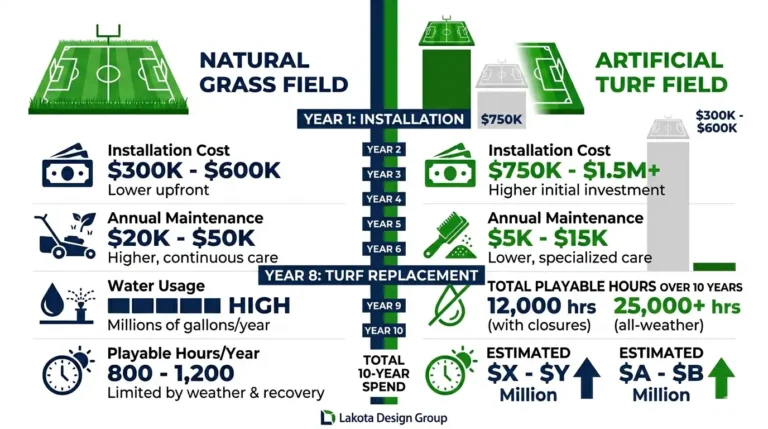
Item | Turf Field | Natural Grass Field |
Installation | $700,000 – $1,200,000 | $200,000 – $500,000 |
Annual Maintenance (x10 yrs) | $50,000 – $150,000 | $400,000 – $600,000 |
Irrigation (x10 yrs) | $0 | $100,000 – $300,000+ |
Equipment | $10,000 – $30,000 | $400,000 – $1,000,000 |
10-Year Total | $760,000 – $1,380,000 | $1,100,000 – $2,400,000 |
Over a full decade, turf almost always wins on total spend. This is the table you need when presenting to a school board or city council.
What Does a Grass Football Field Cost?
Installing natural grass costs less upfront. A basic grass field runs $150,000 – $500,000 depending on size and grading needs.
But the ongoing costs are where grass becomes expensive:
- Mowing equipment: $40,000 – $100,000
- Annual maintenance labor and materials: $40,000 – $60,000/year
- Irrigation system and water usage: millions of gallons per season
- Field closures for recovery after heavy rain or use
According to the Sports Turf Managers Association (STMA), a natural grass football field can require 1 inch of water per week, translating to 60,000+ gallons per day during active seasons. That’s a real utility cost, and one that compounds over time.
You may also want to read this: How much to water new turf?
Natural Grass vs. Artificial Turf: A Cost Perspective
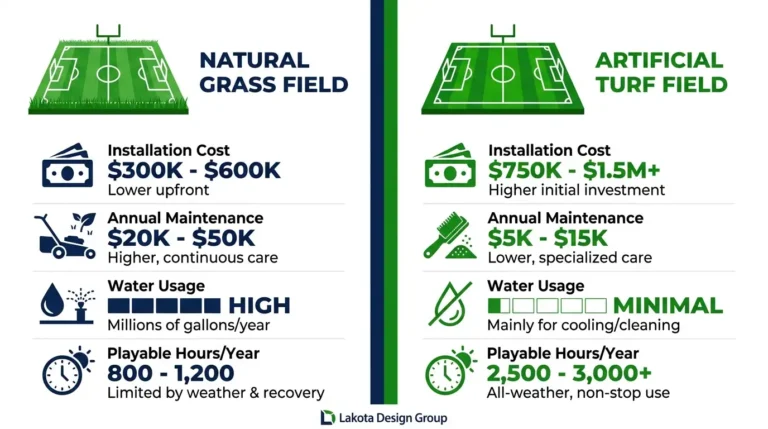
Factor | Artificial Turf | Natural Grass |
Upfront Installation | Higher | Lower |
Annual Maintenance | $5K – $15K | $40K – $60K |
Water Usage | None | High |
Playable Hours/Year | 3,000+ | 800 – 1,200 |
Lifespan | 8 – 15 years | Ongoing |
Weather Cancellations | Rare | Common |
Injury Risk | Lower (no mud, even surface) | Higher in wet conditions |
The availability difference matters more than most budget planners realize. A turf field can host 3x more events per year than natural grass. For schools and municipal facilities that rent field time, that’s real revenue.
You may also want to read this: Artificial Turf and Natural Grass
Indoor Turf Considerations
Indoor football turf installations work differently. You’re typically laying synthetic turf over an existing concrete slab or prepared subfloor, which eliminates most of the base construction costs.
That means no excavation, no drainage system, and no grading. Those savings can be significant. However, a shock pad over concrete is almost always necessary for player safety, and the building itself (structure, HVAC, lighting) is the dominant cost for indoor sports facility projects.
Indoor artificial turf football field cost for the turf surface only (without the building) generally runs $4 – $9 per sq ft, depending on fiber type and shock pad requirements.
How to Get an Accurate Quote
A cost calculator gives you a ballpark. A real quote tells you what you’ll actually spend.
To get accurate bids:
- Define your exact field dimensions including safety zones
- Specify your preferred turf fiber type, pile height, and infill material
- Document your current site conditions (soil type, drainage, slope)
- List all accessories needed (lighting, goals, scoreboard)
- Develop a written RFP (Request for Proposal) and send it to 3+ qualified field builders
When comparing quotes, ask for a full line-item breakdown. Base work, drainage, turf materials, infill, labor, and freight should all be listed separately. This is the only way to make a true apples-to-apples comparison.
Check references. Visit completed fields that are 5–8 years old. Ask about warranty coverage on both the turf materials and the installation.
Financing Your Turf Field Project
Large upfront costs don’t have to stop a project. Common funding paths include:
- School district capital improvement funds or bond measures
- Municipal parks and recreation capital budgets
- State and federal recreation grants
- Community fundraising and booster club campaigns
- Naming rights partnerships with local businesses
- Equipment leasing options through field construction companies
Start the financing conversation early. Some grant applications have long lead times. Naming rights deals can take months to negotiate. Building a funding strategy in parallel with your design and bidding process keeps the project on schedule.
Planning a Turf Field in San Jose? Talk to Lakota Design Group
If you’re evaluating turf installation services in San Jose or anywhere in Northern California, Lakota Design Group has worked on sports facility projects across the region. We understand local permitting, soil conditions, and what a realistic budget looks like for your specific site.
We can walk you through cost estimates, vendor vetting, and the full planning process, so you go into stakeholder meetings with real numbers, not guesses.
Ready to get started? Contact Lakota Design Group today for a consultation.
Conclusion
The average cost of an artificial turf football field runs from $500,000 to over $1,500,000 for a standard installation. Base preparation and drainage take the biggest share of that budget. Turf type, infill choice, labor rates, and accessories make up the rest.
Over a 10-year period, a well-maintained turf field almost always costs less than natural grass when you factor in maintenance, water, equipment, and lost field time. The upfront investment is real, but so is the return.
Get detailed quotes. Compare them line by line. Check references. And plan for the full cost of ownership, not just installation day.
FAQs About Artificial Turf Football Field Installation Cost
How much does a turf football field cost on average?
Most standard installations run $500,000 to $1,500,000. The average cost of artificial turf football field projects for high schools falls around $700,000 to $1,000,000 fully equipped.
How much is turf per square foot for a football field?
Expect $9 to $26 per sq ft for a complete installation including base, drainage, turf, and infill. The turf material alone runs $4 to $9 per sq ft depending on quality.
How long does artificial turf last?
Most synthetic turf field systems last 8 to 15 years. Lifespan depends on usage intensity, maintenance quality, and climate conditions like UV exposure.
What does turf replacement cost?
Replacing the turf carpet and infill without rebuilding the base typically costs $350,000 to $700,000 for a standard field.
Is artificial turf cheaper than natural grass long-term?
Yes, in most cases. Natural grass maintenance can exceed $50,000 per year, while turf maintenance runs $5,000 to $15,000. Over 10 years, turf typically costs less in total.
Can a turf football field be installed indoors?
Yes. Indoor installations skip the base construction costs but still require the turf system, shock pad, and proper subfloor. The building structure is the largest cost for indoor sports facilities.
What infill material is best for a football field?
SBR crumb rubber is the most cost-effective and widely used. EPDM and TPE offer cleaner environmental profiles at higher cost. The right choice depends on your budget, safety priorities, and climate.
How do I get an accurate cost estimate?
Write a detailed RFP with your field dimensions, site conditions, turf specs, and required accessories. Get bids from at least 3 experienced field builders and compare them line by line.